
No products in the cart.
Vaporstorm, 未分类
Advantages & Disadvantages of Monobloc Heat Pump & Split Heat Pump & the Comparison

Monoblock (integrated) type Heat Pump and Split type Heat Pump
ChatGPT say:
Monoblock (integrated) type Heat Pump and Split type Heat Pump each have their own advantages and disadvantages, suitable for different application scenarios. The following is a detailed comparison of them:
Monoblock (integrated) type Heat Pump


Advantages of Monoblock (integrated) type Heat Pump
Easy installation:
The Monoblock (integrated) type has been assembled in the factory, and the on-site installation only requires simple connection work, which reduces the installation time and complexity.
Small footprint:
The Monoblock (integrated) type integrates all components in one casing, takes up less space, and is suitable for places with limited space.
Easy maintenance:
Since all components are in one casing, there is no need to disassemble multiple parts during maintenance and inspection, and maintenance is more convenient and quicker.
Easy to move:
The Monoblock (integrated) type can be moved as a whole, which is suitable for application scenarios that require frequent movement.
Disadvantages of Monoblock (integrated) type Heat Pump
- Noise problem: Since all components such as the compressor and fan are integrated in one casing, the noise of the Monoblock (integrated) type may be large, and additional noise reduction measures may be required.
- Heat accumulation: During the operation of the Monoblock (integrated) type, all components are in a confined space, which may cause heat accumulation and affect the heat dissipation effect.
- Installation restrictions: The installation location of the whole machine may be restricted, and the space and ventilation conditions of the air inlet and outlet need to be considered.

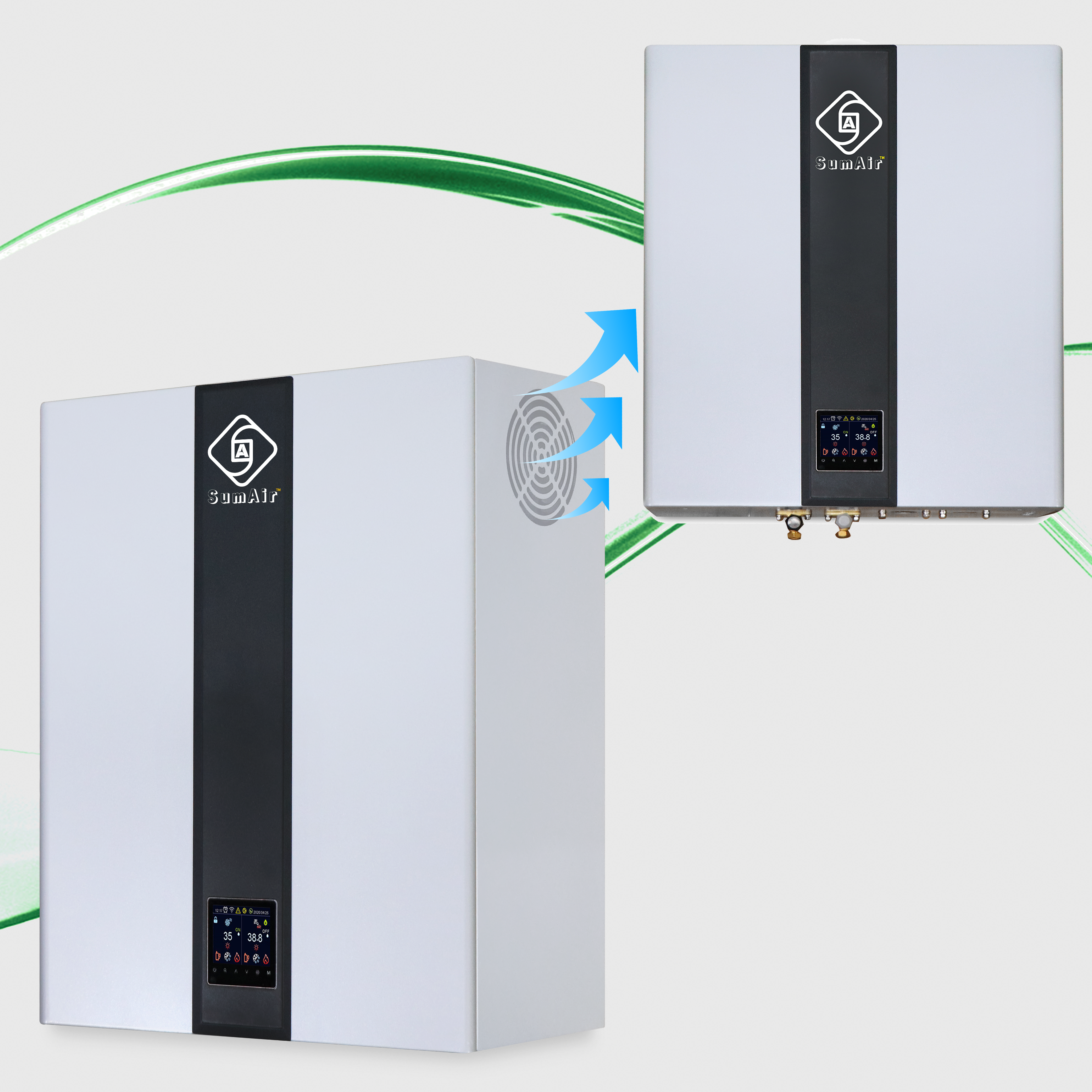
Advantages of Split Heat Pump
Good noise reduction effect:
The split unit installs the noisy compressor and fan separately outdoors, which greatly reduces the indoor noise.
Flexible installation:
The indoor and outdoor units of the split unit can be flexibly installed, suitable for different installation environments and building structures.
Better heat dissipation:
The outdoor unit of the split unit is installed outdoors, with better heat dissipation conditions, which can improve the operating efficiency and life of the heat pump.
Strong aesthetics:
The indoor unit of the split unit is more beautiful in design, and it does not take up too much space when installed indoors, and does not affect the interior decoration effect.
Disadvantages of Split Type Heat Pump
Complex installation:
The split unit needs to be installed and debugged on site, and professional personnel are required for construction, and the installation time and cost are high.
Occupied space:
Although the indoor unit occupies less space, the outdoor unit requires additional installation space, which may have a certain impact on the appearance of the building.
Difficulty in maintenance:
The indoor and outdoor units of the split unit are installed in different locations, and they need to be handled separately during maintenance and inspection, which increases the difficulty of maintenance.
Pipeline installation:
Split units need to install refrigerant pipelines and electrical lines between indoor and outdoor units. The installation of these pipelines may have a certain impact on the building structure.
Comparison and application scenarios on Monoblock Type Heat Pump & Split Type Heat Pump
Applicable scenarios
- Monoblock type unit: Suitable for scenarios with limited space and quick installation, such as small commercial places, small residences, mobile homes, etc.
- Split unit: Suitable for scenarios with high noise requirements and flexible installation, such as high-end residences, large office buildings, hotels, public buildings, etc.
Selection suggestions
Noise control:
If the requirements for noise control are high, it is recommended to choose a split unit, because it places the noise source (compressor) outdoors, which can effectively reduce indoor noise.
Installation space:
If the installation space is limited, it is recommended to choose a Monobloc unit because it occupies less space and is easy to install.
Aesthetics and comfort:
If you have high requirements for indoor aesthetics and comfort, it is recommended to choose a split unit, because its indoor unit is beautifully designed, flexible to install, and does not affect the interior decoration.
Convenient maintenance:
If the convenience of maintenance is more important, it is recommended to choose a Monobloc unit, because all its components are in one casing, and maintenance and repair are relatively simple.
Conclusion
The Monoblock type Heat Pump and the Split type Heat Pump each have their own advantages and disadvantages, and the selection should be comprehensively considered according to the specific application scenario and needs. By weighing factors such as ease of installation, noise control, space occupancy, aesthetics, and ease of maintenance, the most suitable heat pump type can be selected to meet specific usage needs.