
No products in the cart.
Vaporstorm, 未分类
At Least 10,000,000 Additional Heat Pumps by 2027
Question:What’re Heat Pumps do you say?
European Uniion (EU) thinks: Heat pumps are key to enabling the clean energy transition and achieving the EU’s carbon neutrality goal by 2050.
According to Eurostat data, about 50% of all energy consumed in the EU is used for heating and cooling, and more than 70% still comes from fossil fuels (mostly natural gas). In the residential sector, around 80% of the final energy consumption is used for space and water heating.
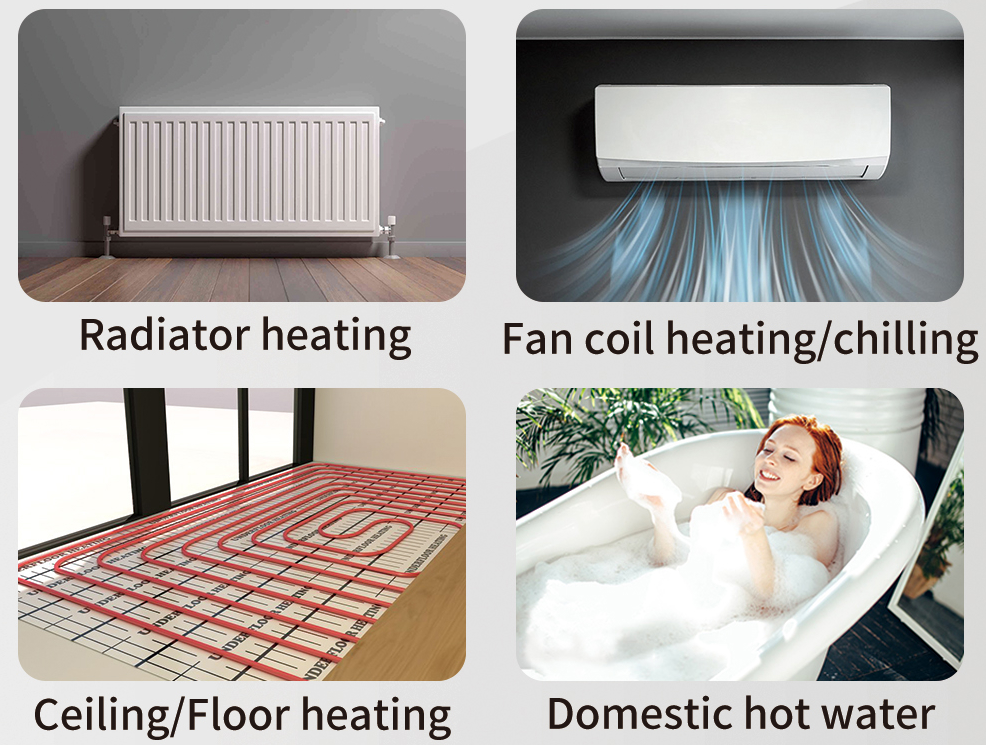
Heat pumps are a mature technology that is much more energy efficient than boilers. They allow greater use of renewable energy sources, ambient energy, and waste heat. In buildings, heat pumps are used for heating, hot water, and in some cases also for cooling. Rather than producing heat, they extract and upgrade ambient energy (heat or cold from outdoor air and surface or sewage waters) or geothermal energy (heat or cold from the ground or groundwaters). The refrigeration cycle is in most cases a vapour compression cycle consuming electrical energy, but there are also sorption cycles that are heat driven.
EU roll-out of heat pumps
A report published in 2022 by the International Energy Agency (IEA) predicts that heat pumps will lower Europe’s gas demand for heating in buildings by at least 21 billion cubic metres in 2030.
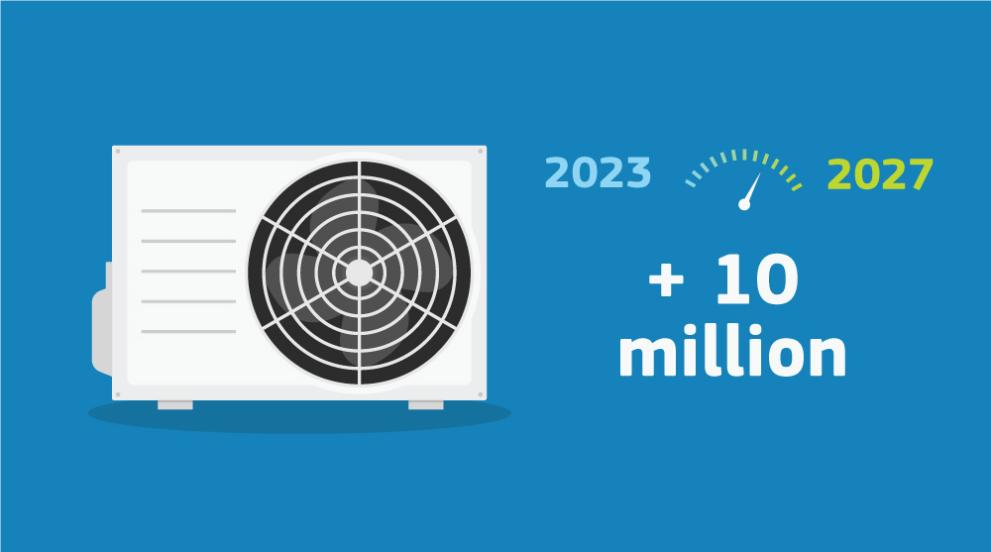
In line with the EU Green Deal goals, the REPowerEU plan calls for frontloading investments in renewables and energy efficiency. It is aimed at reducing fossil fuel imports, doubling the current deployment rate of heat pumps in buildings and speeding up deployment of large district heating and cooling network heat pumps. With 3 million heat pump units installed in 2022 alone, the objective is to install at least 10 million additional heat pumps by 2027.
In addition, with the phase-out of stand-alone boilers by 2029 (under ecodesign rules), the deployment of at least 30 million additional heat pumps can be expected by 2030 compared to 2020, most of them hydronic (including hybrids). This ambition was expressed in the Green Deal Industrial Plan.
New skills around Heat Pump
To ramp up the heat pumps production and their deployment, 750 000 more installers are needed and at least 50% of existing installers will have to be reskilled to work with heat pumps.
Investments on Heat Pumps
The total investment in heat pumps across the EU almost doubled from €13 billion in 2020 to €23 billion in 2023 despite a slow-down in 2023, due to cooling energy prices and subsidy cuts. (Source: BloombergNEF, March 2024)
Social Climate Fund
New financing instruments will support the roll-out of heat pumps. As of 2026, all EU countries will be able to benefit from the Social Climate Fund. It is an €86.7 billion EU Fund that will notably allow EU countries to support energy efficiency measures and the decarbonisation of heating and cooling in buildings, including the installation of heat pumps, for vulnerable households (in particular those in energy poverty) and micro-enterprises.
The Social Climate Fund is sourced by a dedicated share of the revenues from the auctioning of emission allowances under the new emissions trading scheme (“ETS2”) that will put a carbon price on the fuels used in buildings, road transport and other sectors as of 2027, hence further strengthening heat pumps’ competitiveness. Beyond the Social Climate Fund, the ETS2 will also provide significant auction revenues for EU countries to support the green transition notably in the building sector.
EU Heat Pump Action Plan
Heat pumps – the heating solution for a clean energy transition
There is an urgency to switch to renewable efficient heating and cooling technologies in buildings, industry, and networks. The 2022 Commission report on the competitiveness of clean energy technologies indicates that the deployment of all kinds of heat pumps (from single-family houses to large multi-apartment, tertiary buildings and heat network heat pumps to high-temperature heat pumps for industrial applications) is necessary to meet our reinforced climate objectives.
However, without a dedicated EU action plan, 22 million old individual heating appliances and several thousand large old fossil-based heating units are at risk of being replaced by fossil boilers.
A call for evidence on the action plan was launched on 28 April 2023. The input provided will be taken into account as the Commission further develop and fine-tune the initiative. In addition, a public consultation was open between 7 June and 30 August 2023 to allow for additional feedback and ideas.
Heat pumps are an efficient, sustainable and increasingly affordable heating solution that will help Europe in its transition towards a cleaner, greener future.
This 2 minute video explains how heat pumps work and suggests where they can be used. It is available to view or download with subtitles in 22 EU languages
The action plan will aim at accelerating heat pump deployment in the EU through 4 building blocks.
Heat pump accelerator
This partnership will bring together the Commission, EU countries, the sector itself, financial institutions and training providers across the whole heat pump value chain to ensure heat pumps can be widely deployed without downgrading power grid stability.
Communications and skills
Through targeted communication, the action plan will aim to provide citizens, businesses, and small industries with easily accessible information on existing heat pump solutions, the heat-pump readiness of their buildings, industrial plants, and networks, among other topics. A dedicated heat pump skills partnership will aim to provide an operational response to the skills gap in the EU and promote the development of an expert workforce in the sector.
Legislative work
Provisions from the ongoing legislative work will aim to ensure a sufficiently strong policy signal for the heat pump market, including a phase-out by 2029 of stand-alone boilers. It will be supported by various existing EU policy initiatives
- the Renovation Wave (COM/2020/662)
- the ongoing reviews of heating and cooling product-specific regulations under the Ecodesign and Energy Labelling framework
- the ongoing revision of the Energy Performance of Buildings Directive (EPBD), the Renewable Energy Directive (RED) and the Energy Efficiency Directive (EED)
- the Social Climate Fund (EU/2023/955)
- the revision of the ETS Directive (EU/2023/959)
- Article 122 Emergency measure on permitting for renewables (COM/2022/591)
- the revision of the Electricity Market Design (COM/2023/148)
- Commission’s proposal for a Net-Zero Industry Act (COM/2023/161) and for a Critical Raw Materials Act (COM/2023/160)
- Commission’s proposal for the recast of the Energy Taxation Directive (COM/2021/563) and for a Regulation on fluorinated greenhouse gases (COM/2022/150)
Financing
In order to facilitate access to all relevant EU funding programmes, the action plan will come with a mapping of financing possibilities for both heat pump deployment at the individual level and heating networks supplied by large heat pumps, as part of heating and cooling strategies at local and regional levels.
Related links
- Have your say – heat pumps action plan
- Energy label and ecodesign of space and water heaters
- 2022 Competitiveness Progress report
- RePowerEU plan
- European Green Deal
- Frequently asked questions – European heat pump association
On what’re heat pumps, ChatGPT says:
A heat pump is a device used for heating and cooling buildings. It works by transferring heat from one place to another rather than generating heat directly. In the winter, it extracts heat from the outside air or ground and brings it inside. In the summer, it reverses the process by removing heat from the inside of the building and releasing it outside. Heat pumps are known for their energy efficiency because they move heat rather than producing it from scratch.
And Chinese National Popular Source Engin believes:
A heat pump water heater is an efficient thermal energy lifting and transfer device based on the reverse Carnot cycle. It uses a small amount of electrical energy as power and refrigerant as a carrier to continuously absorb low-grade thermal energy from the air, convert it into usable high-grade thermal energy, and then release the high-grade thermal energy into the water that needs to be heated to produce domestic hot water, which is then transported to users through hot water pipelines. It can transfer the heat from low-temperature heat sources (such as air, soil, seawater, groundwater, etc.) to the water that needs to be heated, achieving the function of heating water.
WIKIPEDIA. ORG elaborate Heat Pumps should be:
A heat pump is a device that consumes energy (usually electricity) to transfer heat from a cold heat sink to a hot heat sink. Specifically, the heat pump transfers thermal energy using a refrigeration cycle, cooling the cool space and warming the warm space.[1] In cold weather, a heat pump can move heat from the cool outdoors to warm a house (e.g. winter); the pump may also be designed to move heat from the house to the warmer outdoors in warm weather (e.g. summer). As they transfer heat rather than generating heat, they are more energy-efficient than other ways of heating or cooling a home.[2]
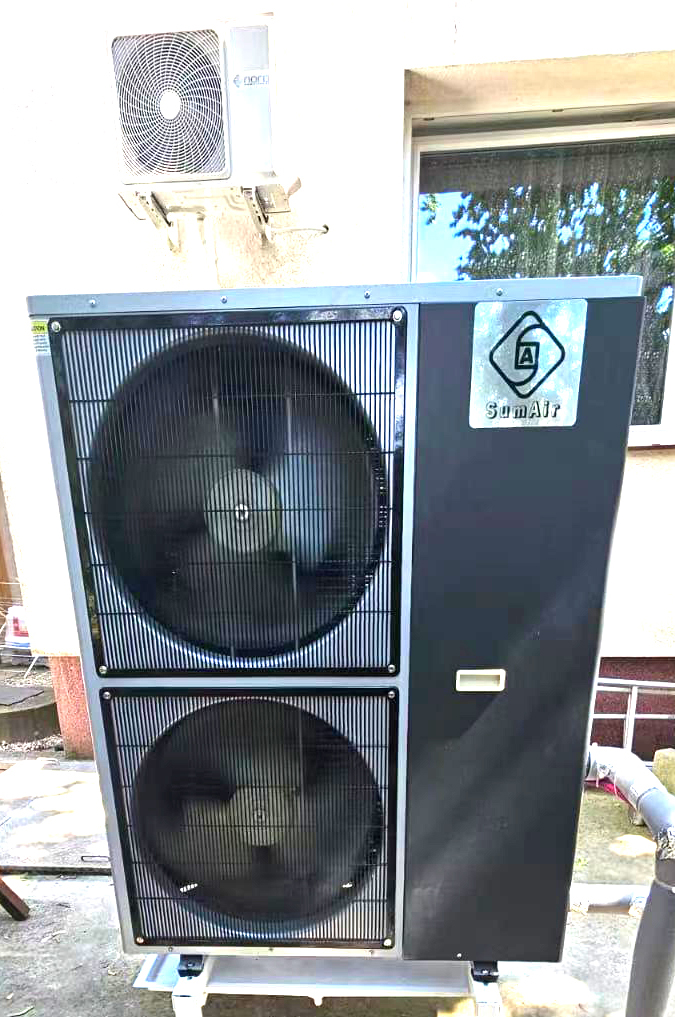
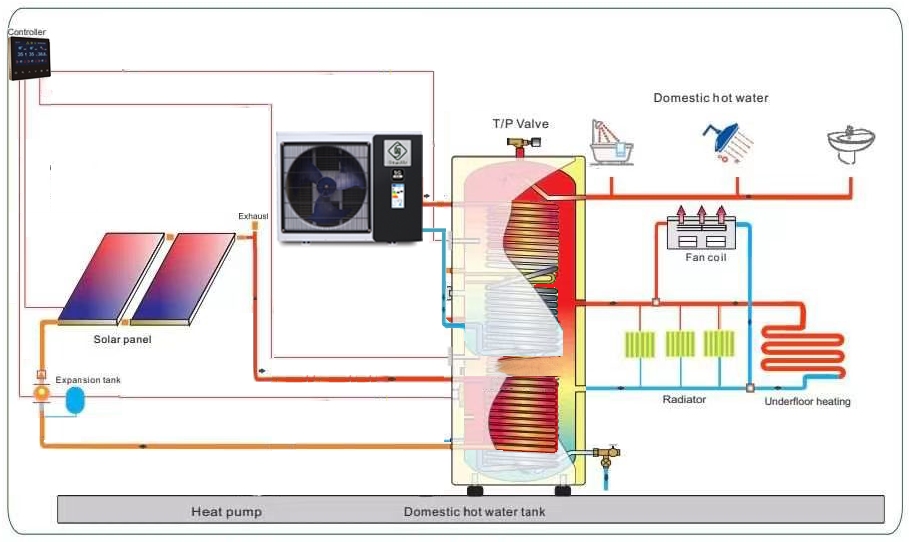
A gaseous refrigerant is compressed so its pressure and temperature rise. When operating as a heater in cold weather, the warmed gas flows to a heat exchanger in the indoor space where some of its thermal energy is transferred to that indoor space, causing the gas to condense to its liquid state. The liquified refrigerant flows to a heat exchanger in the outdoor space where the pressure falls, the liquid evaporates and the temperature of the gas falls. It is now colder than the temperature of the outdoor space being used as a heat source. It can again take up energy from the heat source, be compressed and repeat the cycle.Air source heat pumps are the most common models, while other types include ground source heat pumps, water source heat pumps
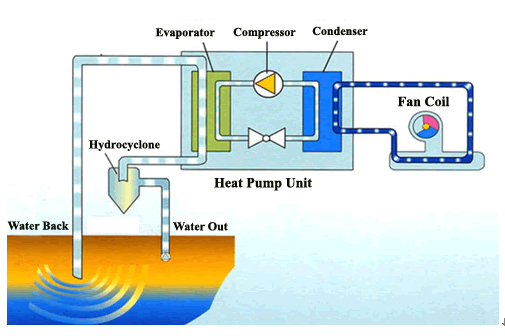
and exhaust air heat pumps.[3] Large-scale heat pumps are also used in district heating systems.[4]The efficiency of a heat pump is expressed as a coefficient of performance (COP), or seasonal coefficient of performance (SCOP). The higher the number, the more efficient a heat pump is. For example, an air-to-water heat pump that produces 6kW at a SCOP of 4.62 will give over 4kW of energy into a heating system for every kilowatt of energy that the heat pump uses itself to operate. When used for space heating, heat pumps are typically more energy-efficient than electric resistance and other heaters.Because of their high efficiency and the increasing share of fossil-free sources in electrical grids, heat pumps are playing a key role in climate change mitigation.[5][6] Consuming 1 kWh of electricity, they can transfer 1[7] to 4.5 kWh of thermal energy into a building. The carbon footprint of heat pumps depends on how electricity is generated, but they usually reduce emissions.[8] Heat pumps could satisfy over 80% of global space and water heating needs with a lower carbon footprint than gas-fired condensing boilers: however, in 2021 they only met 10%.[4]